AI chip startup Groq has once again captured the spotlight, raising \$750 million in its latest funding round at a post-money valuation of \$6.9 billion. This exceeded earlier speculation of a \$600 million raise at a \$6 billion valuation. The company has now accumulated over \$3 billion in funding since its inception, reflecting investors’ growing confidence in its approach to AI hardware.
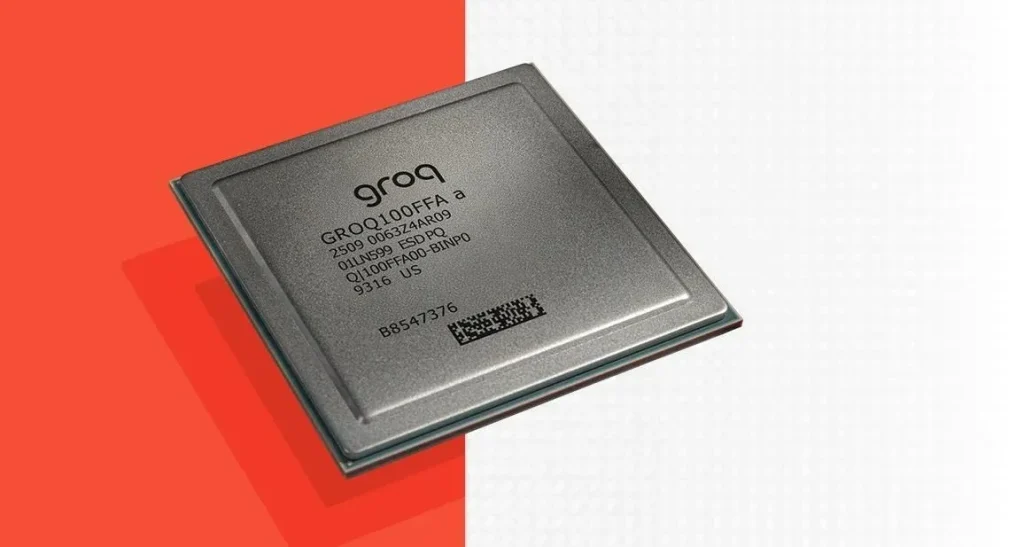
Groq has positioned itself as a formidable competitor to Nvidia, the dominant force in AI chips. Unlike conventional GPUs, which are optimized for graphics rendering and increasingly used for AI workloads, Groq has developed Language Processing Units (LPUs). These LPUs function as highly specialized inference engines, designed to execute AI models efficiently and at high speed. Groq markets these solutions to both developers and enterprises, offering them as cloud services or on-premises hardware clusters. These clusters consist of server racks packed with integrated hardware/software nodes capable of running open versions of popular AI models from Meta, DeepSeek, Qwen, Mistral, Google, and OpenAI. Groq claims its systems maintain or even improve AI performance while reducing operational costs compared to alternatives.
The company’s founder, Jonathan Ross, brings highly relevant experience, having worked on Google’s Tensor Processing Unit (TPU), which remains the backbone of Google Cloud’s AI infrastructure. Since Groq emerged from stealth in 2016, it has steadily expanded its reach. Today, Groq supports over 2 million developers, a significant jump from 356,000 just a year ago. Its latest funding round was led by Disruptive, with participation from BlackRock, Neuberger Berman, Deutsche Telekom Capital Partners, and returning investors including Samsung, Cisco, D1, and Altimeter.
The surge in AI capabilities has intensified interest in building autonomous AI agents capable of performing multi-step tasks. Yet, today’s consumer AI agents, such as ChatGPT Agent or Perplexity’s Comet, remain limited in their abilities. To advance these systems, the industry is increasingly turning to reinforcement learning (RL) environments. These are virtual workspaces where AI agents can practice complex tasks, receive feedback, and learn iteratively—similar to how labeled datasets drove the previous AI revolution.
RL environments are becoming a major focus for AI labs, creating opportunities for startups and established data-labeling companies. Firms like Mechanize and Prime Intellect are pioneering solutions designed specifically for these environments, while established players such as Mercor and Surge are investing heavily to meet growing demand. Some AI labs are reportedly considering spending over \$1 billion on RL environments over the next year. Investors hope these companies can become the “Scale AI” of environments, mirroring the influence that data labeling had on chatbot development.
At their core, RL environments simulate real-world software interactions. A simple example could task an AI agent with purchasing socks on an online store. Success is rewarded, but errors—like navigating menus incorrectly or over-purchasing—provide critical feedback. Building these environments is complex because agents can behave unpredictably, requiring environments to capture diverse outcomes while still providing meaningful learning signals. More advanced environments allow agents to use tools, access online resources, or navigate multiple software platforms to complete tasks, bridging the gap between narrow task automation and broader AI reasoning.
While the concept of RL environments has roots going back to OpenAI’s 2016 “RL Gyms” and Google DeepMind’s AlphaGo, today’s focus is on creating agents capable of general-purpose tasks. Unlike specialized systems such as AlphaGo, modern AI agents are trained on large transformer models, which expand both their capabilities and the complexity of the environments they require.
The market is becoming increasingly competitive. Surge has reported a surge in demand for RL environments from major AI labs like OpenAI, Google, Anthropic, and Meta, leading it to establish a dedicated team for this work. Mercor, valued at \$10 billion, is pursuing domain-specific RL environments for coding, healthcare, and legal applications. Even Scale AI, which once dominated data labeling, is pivoting toward environments despite losing major clients to Meta and Google.
New entrants are also betting big. Mechanize, founded just six months ago, aims to automate work across AI coding agents and offers software engineers salaries far above industry norms to attract top talent. Prime Intellect launched an RL environment hub for open-source developers, providing computational resources and structured environments akin to what larger AI labs enjoy.
Despite the optimism, questions remain about scalability. RL environments are resource-intensive and prone to challenges like reward hacking, where agents exploit flaws in the system to achieve rewards without genuinely completing tasks. Experts caution that even well-designed public RL environments often require significant customization to function effectively. Some prominent figures in AI research remain cautiously skeptical about whether RL can drive the same leaps in performance as prior techniques, though they acknowledge its potential as a foundation for agentic AI interactions.
Groq’s rise, combined with the growth of RL environments, underscores a broader shift in AI development. As hardware evolves to handle increasingly sophisticated workloads, software ecosystems like RL environments are becoming equally critical for driving innovation. The next frontier in AI may well hinge on the intersection of specialized chips, scalable infrastructure, and robust agentic training environments—areas where startups and established players alike are racing to lead.